F1
Action & Adventure
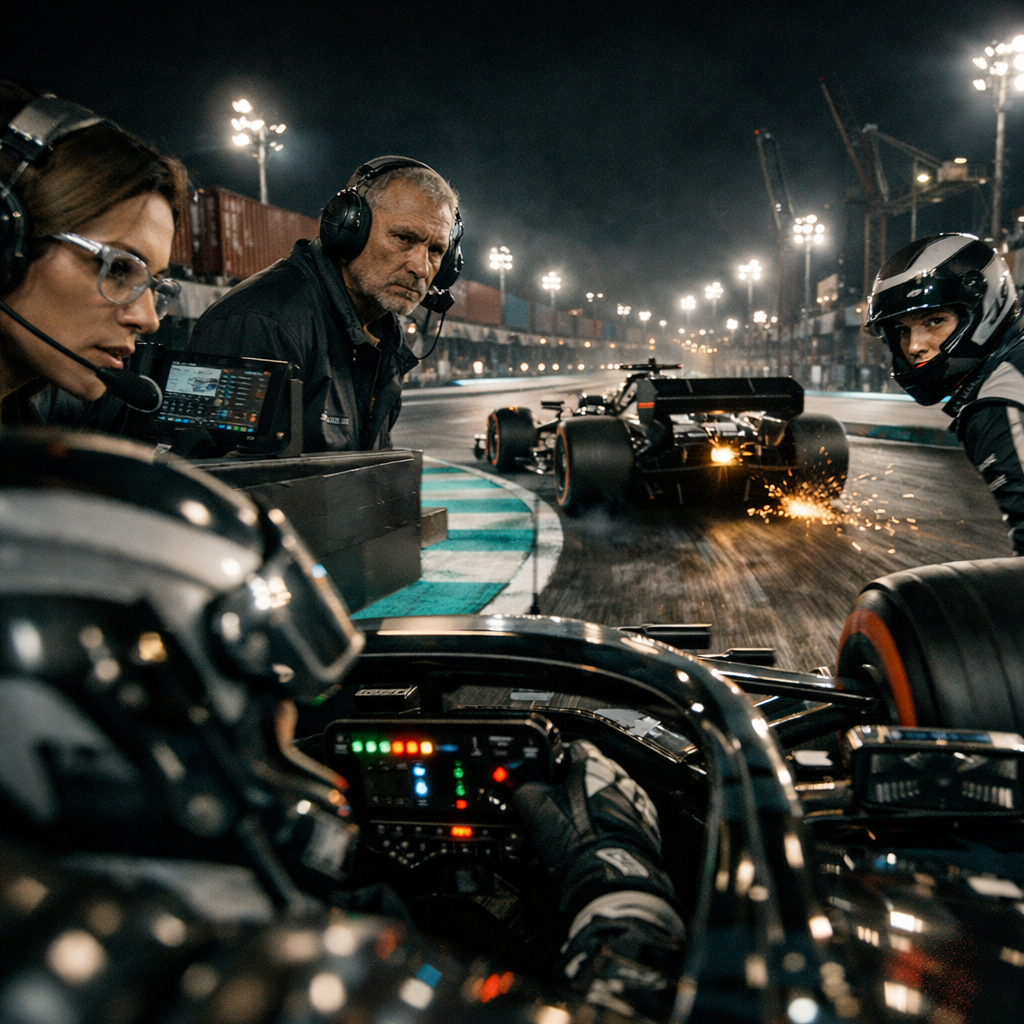
The first warning isn’t the wall rushing closer—it’s the brake pedal that briefly stops feeling like yours.
You’re on the Kestrel Street Circuit, lap 14, night wrapped around the floodlights like a tight fist. The car is planted, engine screaming at a pitch that turns thought into vibration. Container stacks blur into metallic stripes. The sea wall flashes by, a pale line beyond the fencing, and you taste salt through the vented air.
“Mode push. Gap one-point-two,” Mara says in your ear, her voice as steady as a timing loop.
You nod even though she can’t see it. Your right thumb flicks a rotary. The wheel’s LEDs chase upward—green, blue, then the hard white that means you’re at the edge of what the power unit will give.
Turn 12 is the end of the longest straight: a fast approach, late braking, a corner that punishes hesitation. You line up the braking boards—150, 100, 50—everything familiar, everything repeatable.
At the 80 board, your foot goes for the brake.
The pedal firms—then it pulses once, like a heartbeat that isn’t yours.
Your stomach drops in a clean, cold line. The car’s nose dips a fraction more than you commanded. It’s subtle. It’s the kind of subtlety that becomes a crash if you ignore it at 320.
You feather the brake, correct with micro-steering. The car survives the corner on the knife-edge, the rear stepping out just enough to remind you it could have chosen violence.
“Fronts are fine,” Mara says immediately, too quickly, as if she’s answering a question you haven’t asked.
You don’t reply. Your eyes are already hunting the next markers.
Through the next sector, everything looks normal: temps stable, ERS deployment where you want it, steering angle matching your muscle memory. Yet the feeling lingers—an interference, a hand over your hand.
On the back straight, you test it. A tiny brush of brake pressure—barely a touch.
The telemetry overlay on your dash flickers with a warning you’ve never seen in a race: INPUT CONFLICT.
Your throat tightens. That message should be impossible. The car reads your steering wheel, your pedals, your sensors. There is no second driver.
“Copy?” you ask, keeping your tone neutral because fear takes up space, and you can’t spare any.
Static. Then Mara: “We see… a spike. Might be noise. Stay focused.”
Noise doesn’t feel like a pulse in your foot.
Ahead, Selene Rook’s car slices through the light, rear wing shimmering like a blade. She’s within reach—close enough that one brave move could put you in clean air and control the race.
But your right foot is suddenly a question.
As you cross the line, the pit entry opens to your right like a mouth: bright, safe, slow. The track continues straight ahead into speed and darkness.
On the radio, Mara’s voice lowers, almost private. “Nico. We have an FIA auditor in the garage. He wants to talk. Now.”
The car surges toward Turn 1, and you realize you’re making two races at once: one against Selene, and one against whoever is inside your machine.
What happens next?
Want to riff your own version of this story? Get RiffRoc