Riddle Do, Riddle Don’t
Mystery & Crime
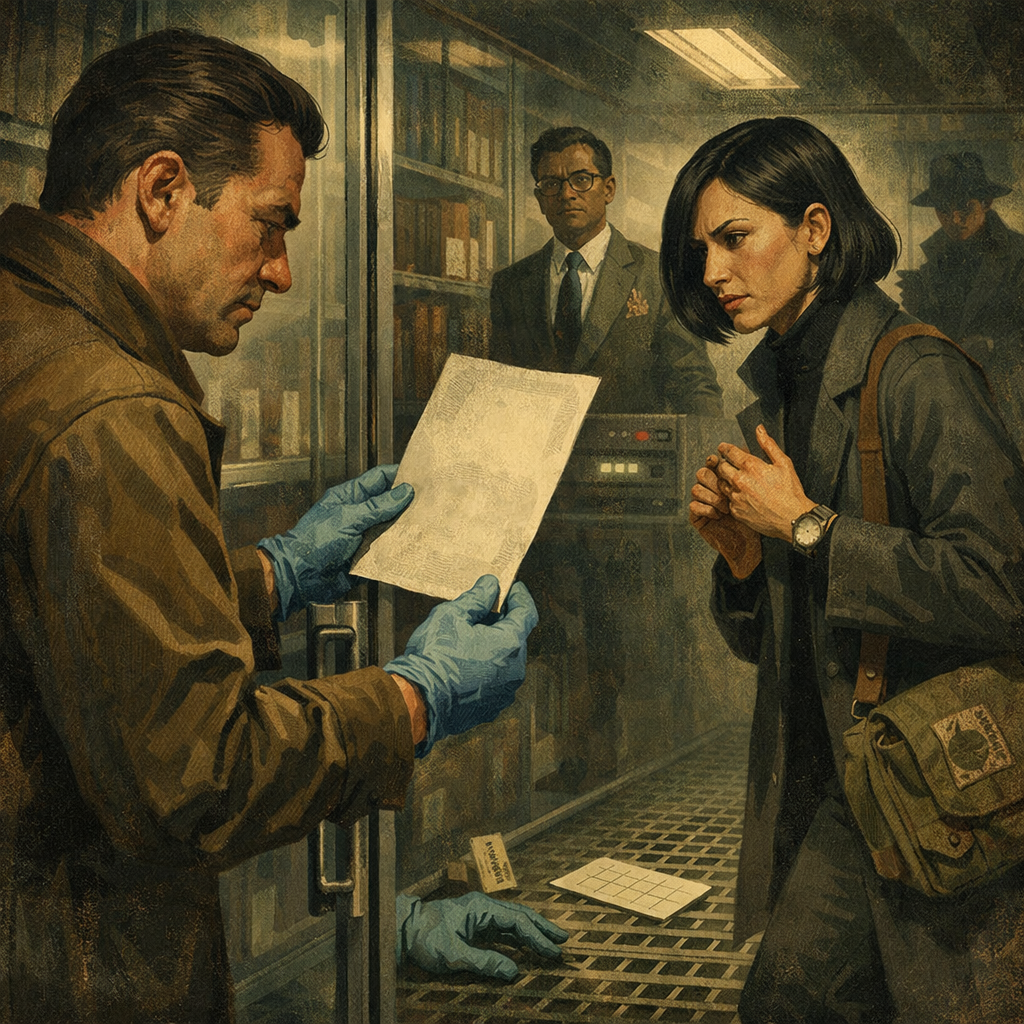
The archive’s rare book room is built to make you believe in airtight endings. Glass walls. A metal grate floor that turns footsteps into announcements. Cold air hissing from vents so steady it feels like a verdict that never sleeps.
The man on the floor doesn’t match the room.
He lies half on his side, one arm tucked awkwardly under his ribs as if he’d tried to protect something small and sharp. His face is slack in that private way death always is, like a person has finally stopped editing themselves. No blood, no spectacle. Just a stillness that makes the air seem louder.
I’m not supposed to be here. That’s the first fact that arrives, clean and ugly.
Detective Inez Calderón stands at the threshold, keeping her shoes on the safe side of the tape as if the line could bite. Her blazer sleeves are pushed up, forearms tense with the kind of restraint that looks like patience until you realize it’s disgust at chaos. She doesn’t look at the body for long. She looks at the room, at the lock, at the glass, at me.
“You said you don’t work here,” she says, and her voice is calm enough to be dangerous.
“I don’t,” I answer, because it’s true in the way half-truths are true. “Not anymore. I edit crosswords. I used to intern in cataloging.”
Across the glass, Dr. Saira Nand stands with her hands folded so tightly the knuckles shine. Amber-framed glasses. A faint lavender smell that has no business competing with old paper and chilled air. She watches the dead man without letting her expression fully form, like she’s afraid a face might be evidence.
“That’s Jun Park,” she says, and the name lands with the soft weight of someone known only inside a system. “Night conservator. He shouldn’t have been in the vault alone.”
Owen Rusk, the security supervisor, hovers near the access panel with his lanyard clip squeaking under his thumb. Peppermint. Sweat. A practiced readiness to say the wrong thing before anyone asks the right question.
Calderón holds up a sheet of paper in a gloved hand. “The warrant lets us search restricted areas for forty-eight hours. After that, you lock this place down again, and anything we missed stays missed. Understood?”
Nand’s jaw tightens once. “Understood.”
Then Calderón turns the paper so I can see. An access log printout: times, badge IDs, door states. I’ve read enough of these to know the rhythm. Enter, exit, enter. Tonight’s rhythm stutters.
“Your security system says the vault door opened at 2:17 a.m.,” Calderón says. “But Dr. Nand told patrol she did a walk-through at 2:24 and everything was normal. Seven minutes.”
Nand doesn’t argue. She just blinks once, slow, as if she’s choosing which version of herself to be.
On the floor, near Jun Park’s hand, lies a small card, plain white, the kind you’d tuck in a catalog drawer. The edges are slightly softened, handled. I can see pencil marks even from here: cramped letters, a grid-like arrangement, the careful impatience of someone who thinks in constraints.
Rusk clears his throat. “We didn’t touch it,” he says quickly. Too quickly.
Calderón looks at me again, and this time her gaze isn’t just suspicion. It’s appraisal. Usefulness weighed against risk. “You’re a puzzle person,” she says. Not a compliment. A category.
The vault’s cold finds the gap at my collar and slips down my spine. I watch the card the way I watch an unfinished clue, feeling the old pull in my hands, that wanting to solve before I’m allowed to want anything else.
Calderón’s gloved fingers hover over the latch on the glass door. “If you step in, it’s on record,” she says softly. “If you don’t, you go home. Either way, that card exists.”
On the card, I can make out the first line now: WHEN I AM TAKEN, I AM NOT STOLEN.
And beneath it, a second line that feels like it’s looking straight back at me: NAME THE THING YOU USED TO HIDE.
What happens next?
Want to riff your own version of this story? Get RiffRoc