Billy: The Kid
Western
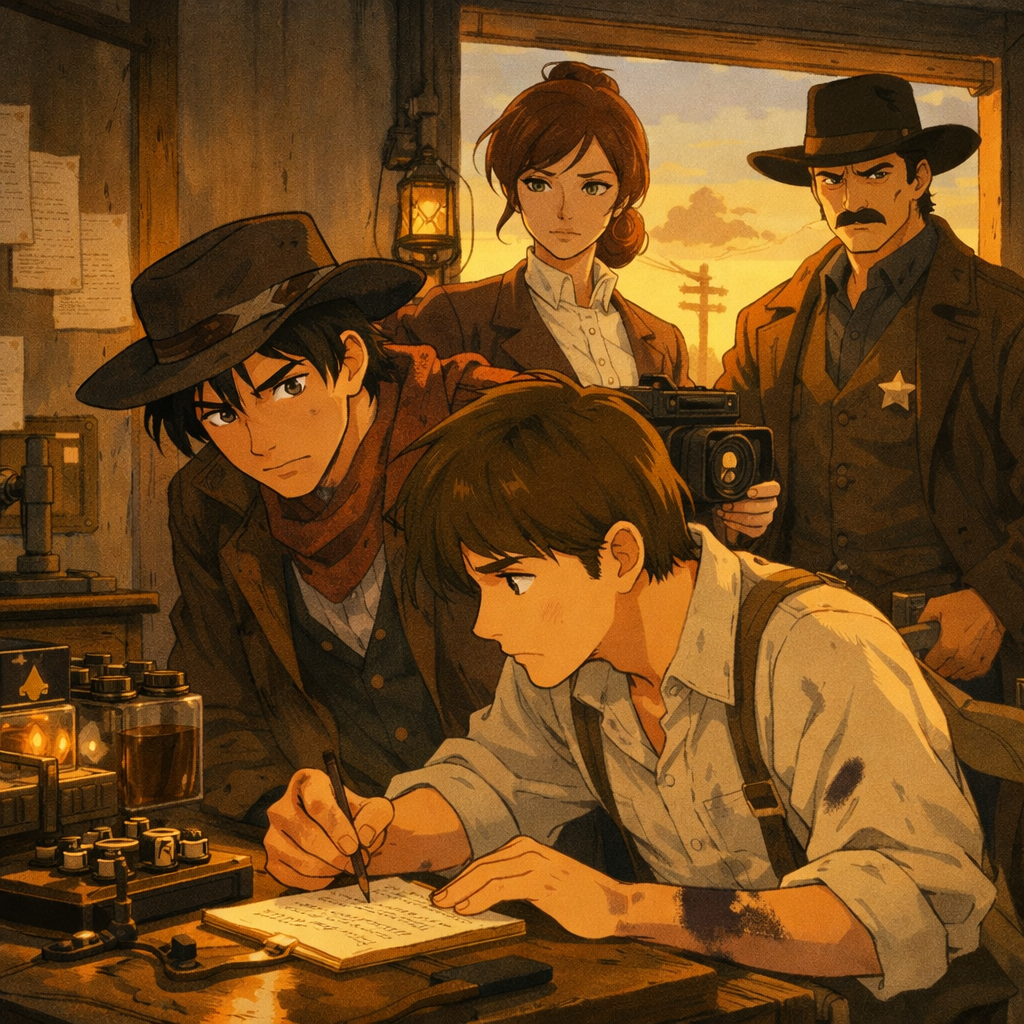
You learned early that the wire doesn’t care what’s true. It only cares what gets sent.
The message came in near sundown, when Fort Sumner’s main street turned the color of old brass and the wind started worrying the signboards like it meant to pull them loose. You’d been alone in the telegraph office all afternoon, listening to the Singing Line’s faint vibration outside and the steady, insect-click of your key inside.
Then the line stuttered.
Three sharp bursts, a pause, then a string of characters that made your stomach tighten—not because you understood them at first, but because whoever sent them didn’t use the public code. They used the ranchers’ private number-cipher. The kind of thing men pay for so their threats can travel faster than law.
You copied it down anyway, the pencil moving on instinct.
When you decoded it, the sentence sat on your paper like a dead thing:
BILLY BONNEY IS ALREADY BURIED. PROOF RIDES TO YOU. KEEP GARRETT OUT.
As if you could.
A wagon arrived less than an hour later, rolling in behind the livery with its lanterns hooded. Not a freight wagon—too tidy. Not a preacher’s—no hymn on the wind. It carried a small painted sign on the side, letters neat as a schoolbook: ADA LARK, PHOTOGRAPHS TAKEN. LIKENESSES IN MINUTES.
You watched from your doorway as she climbed down. The woman moved like she had a map in her head and no interest in anyone else’s. She glanced once at the telegraph office, and in that glance you felt seen in the precise, unpleasant way a lock feels a key.
She came in without asking.
Up close, she smelled faintly of sharp chemicals and dust—like rain that never arrives. She set a flat parcel on your desk and didn’t sit.
“Are you the one on the wire?” she asked.
“I’m the one who answers it,” you said.
“That’ll do.” She unwrapped the parcel with careful fingers.
Inside was a photograph.
A small, glossy plate mounted on stiff card. A man laid out on a table, face turned toward the camera, eyes closed. A hat on his chest. A revolver near his hand, placed like punctuation. The light in the picture was wrong—too clean, too purposeful.
But the face—
You’d seen it on broadsides, in cheap newspapers, in the way men in saloons described him with envy. The mouth that could be kindness or mockery depending on the day. The sharp line of the nose.
Billy the Kid.
Ada watched you study it, her expression flat.
“Before you decide what you think you’re looking at,” she said, “you should know two things. First: pictures can lie. Second: somebody is willing to kill to make this one feel true.”
Outside, a bootheel scraped on the boardwalk. Slow. Deliberate. Someone pausing just long enough to listen.
Ada’s eyes flicked to the window.
“You’ve got about a minute,” she said softly, “before the law asks to see what you’ve just been handed.”
What happens next?
Want to riff your own version of this story? Get RiffRoc