14th of September
Literary Fiction
The 14th of September had the nerve to be beautiful.
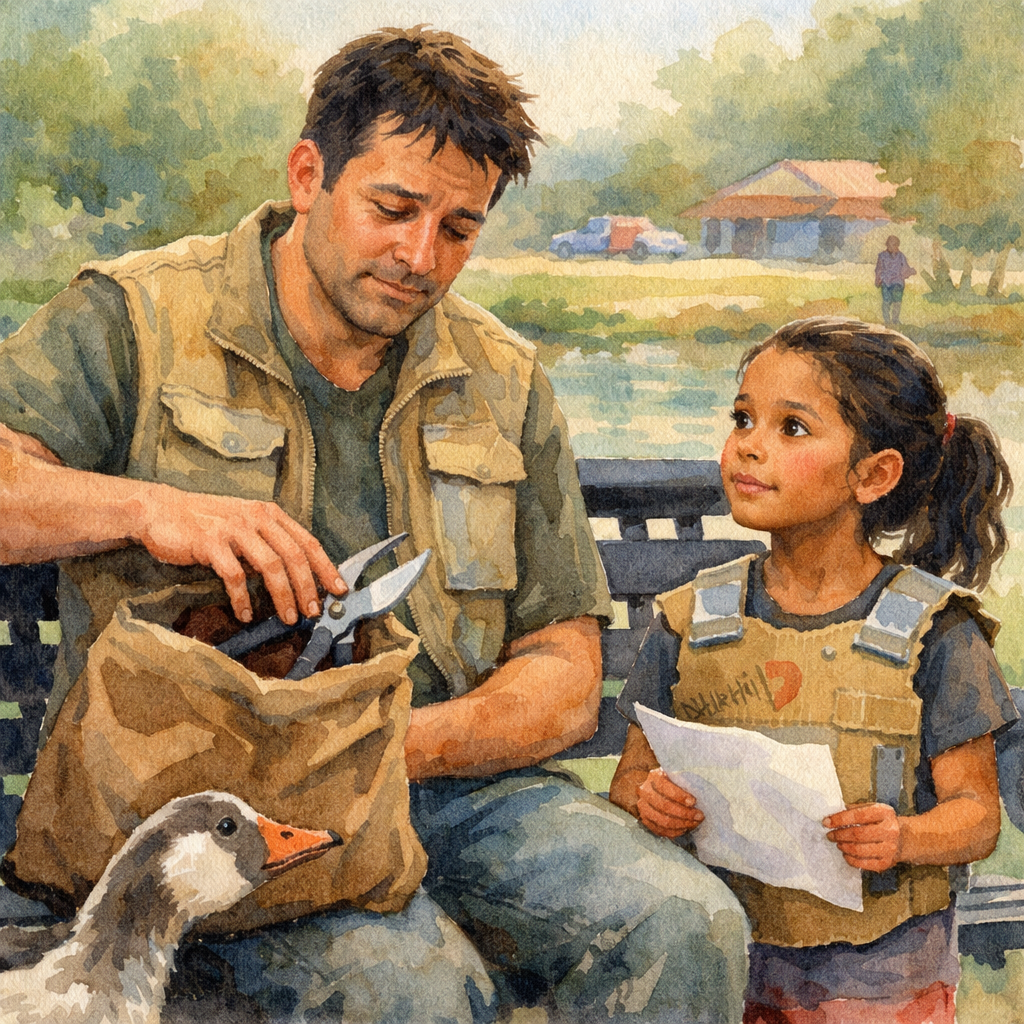
Walt Keene had counted on weather that would agree with him. A little rain. A little ugliness. Instead: that high thin blue you got after Labor Day, the pond doing its cheap glitter, a jogger in lime, geese arguing like they paid taxes. He had a paper sack. In the sack, Ruth's garden shears, still sharp, still with the green handle she'd wrapped in electrical tape because the factory grip had betrayed her in '09, a year she had been very alive and very annoyed.
The Plan (he had begun capitalizing it, which was a bad sign, a sign of a man making a ceremony out of a chore) was: walk to the scabby bench. Leave the shears. Do not give a speech. Go home. Eat something beige. Prove, by beige, that the day had not gotten him.
He was sixty-six. Ruth had been gone eleven months, which was long enough that people had stopped using the soft voice and not long enough that the house had stopped arranging itself around a person who did not come down the hall. September 14th would have been forty years. He had not wanted a party. He had wanted, with a practical ferocity that embarrassed him, to be a man who could put an object down and not pick it up.
He sat. The bench accepted him with the indifference of municipal iron. A goose approached, assessed the sack, was disappointed. Walt heard himself think: You see? Even the goose. And then: Stop. You are not a tragic figure. You are a man with shears.
"Excuse me," said a voice at his knee-level. "Are you the person who knows if this is allowed."
A girl. Nine, maybe. Brown knees. A cardboard breastplate duct-taped across her T-shirt. CITIZEN, in marker, the N backwards. A worksheet flapping in her hand, the heading in teacher-font: EVIDENCE OF GOOD. Behind her, the path, the rec-center roof, a distant adult who was not, at this moment, an adult.
Walt's first thought was: I am wearing a fishing vest. His second: She thinks I work here. His third, treacherous: If I say no I can still leave the shears and go, and this will have been a story I tell no one.
The girl waited. She had the patience of a person who believed in badges.
"I'm not," Walt said, and heard how little that helped. "I'm just. Sitting."
"Oh." She looked at the sack. At the vest. At the pond, as if the pond might hire him on the spot. "That's okay. Sitting can be allowed. I have to find evidence. Ms. Gokhale said it has to be real and not from TV. My mom is in the lot. She's on a call. She said don't go in the water. I didn't."
Walt looked at the parking lot. Sun on windshields. A minivan, maybe hers, maybe not. Daylight. Joggers. He was not a villain in a story. He was a man with a Plan that had not budgeted for a citizen.
The shears made a small sound in the sack, like they wanted to be useful.
He could tell her, kindly, to go back to the lot. He could also, against The Plan, remain a person who was still here.
What happens next?
Want to riff your own version of this story? Get RiffRoc