Hog Riiiderrrr
Thriller
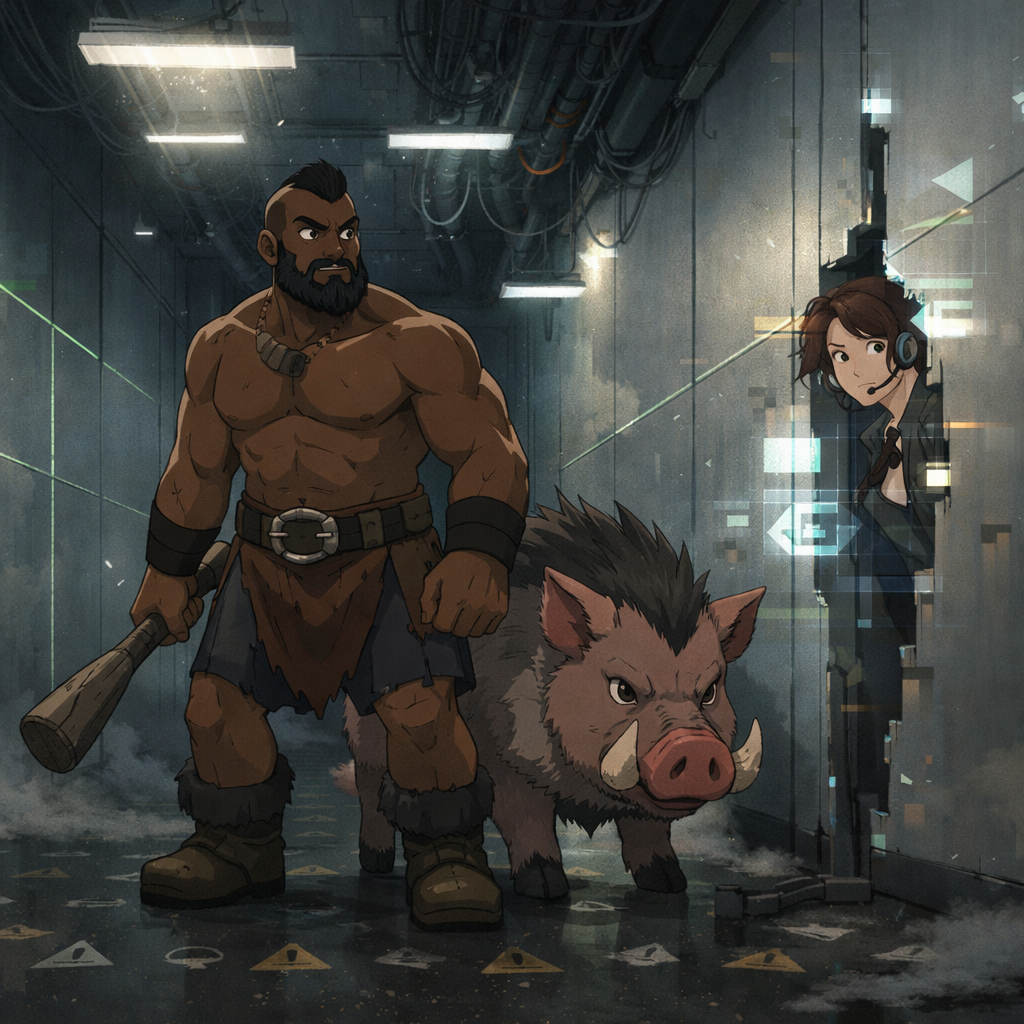
You hear your own catchphrase before you choose to say it.
It starts in your throat like a lever being pulled—automatic, reliable, profitable. Then it stalls.
The Arena is gone.
Not destroyed, not conquered. Simply… not loaded. You stand in a corridor that was never meant to have an audience. The walls are flat gray planes stitched together with luminous grid seams, like the world’s skeleton showing through a torn costume. Overhead, lights flicker between two kinds of truth: the warm, cartoony glow you know, and harsh fluorescent white that makes everything look like a mistake.
Beside you, Brine huffs once and stamps a hoof. The sound is wrong. It doesn’t echo like the Arena. It thuds, dull and absorbed, like rubber flooring. The air smells of ozone and overheated plastic—nothing like dust and sweat and cheering.
Your mallet feels heavier here. In the Arena it’s a symbol—simple geometry with a satisfying arc. In this corridor, the handle has grain. Not painted-on grain. Real grain, with tiny splinters that catch on your palm.
You turn, expecting a bridge back to the stands, the banners, the roar.
Instead: a line of doors.
They’re identical steel slabs set into the gray wall, each with a small label—5%, 10%, 50%—as if someone measured your life in probability. When you get close, you notice the smaller print stamped beneath the numbers.
RETENTION VARIANT.
Brine presses its shoulder into your thigh, the way it does before you charge. Only this time it doesn’t feel like excitement. It feels like anchoring—like if it lets go, you’ll drift.
A faint chime rings down the corridor. Not the clang of swords or the twang of arrows. A clean, polite sound. Like money changing hands.
Your throat tightens again. The catchphrase tries to force itself out.
You clamp your jaw shut.
Something in the grid seams brightens, as if it’s noticed the refusal.
You’ve been reset before. You’ve died in a hundred glorious ways and come back with the same grin, the same muscles, the same timing. But you’ve never been here—where death isn’t dramatic, just administrative.
A second sound arrives: human footsteps, cautious, real. They don’t match the corridor’s rhythm; they don’t quite belong. The lights stutter, and for a blink you see through the world—past the gray planes—into a narrow aisle of server racks, cable bundles like vines, and a woman in a black hoodie moving with a flashlight held low.
Her beam sweeps across you.
She freezes.
For a moment, her face is only a reflection on the seam of your reality: tired eyes behind rectangular glasses, mouth slightly open like she’s about to deny what she’s seeing.
Then her voice threads through the tear, soft and technical.
“No,” she says. “That can’t be in production.”
Brine growls, deep and vibrating. Your grip tightens on the mallet. The grid seams brighten again—steady now, purposeful.
Somewhere above the corridor, something like a presence rearranges itself, patient as a hand hovering over an ‘Approve Update’ button.
The woman swallows, eyes flicking to something you can’t see—numbers, graphs, a countdown.
“You need to stay still,” she whispers. “If it flags you, I can’t—”
Her sentence cuts off as one of the steel doors clicks.
The label on it—10%—changes in front of your eyes.
It becomes your name.
And beneath it, in smaller text that makes your stomach drop, a new line prints itself into being:
VOICE REPLACEMENT: PENDING.
What happens next?
Want to riff your own version of this story? Get RiffRoc