GW: The Father
Historical Fiction
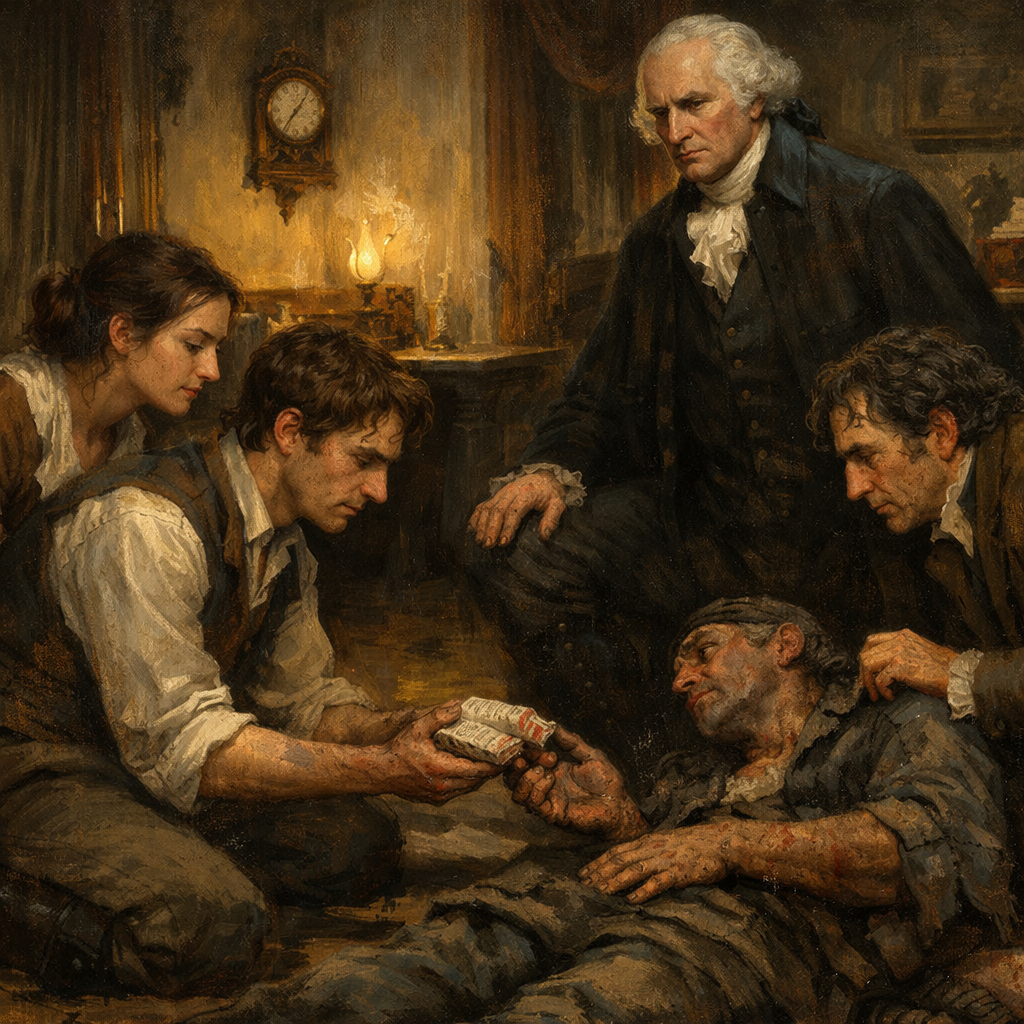
The packet is still warm when it reaches your hand, as if the dead man who carried it has only just let go.
You stand in the narrow corridor outside the President’s study, listening to the house pretend it is not afraid. Floorboards settle. A distant clock ticks through the heat. Somewhere in the kitchen, someone pours vinegar into a bowl—an offering to an invisible enemy that does not bargain.
The messenger had arrived at dusk, swaying on his feet. A dockworker by the look of him—salt embedded in his seams, hands cracked and blackened around the nails. He spoke a name you didn’t catch, then folded at the threshold as neatly as a man kneeling. When you knelt beside him, his skin was too hot and too dry. His eyes tried to focus on you and failed.
His fingers had been clenched around the packet as if it were the last part of him still on duty.
Now the sealing wax bears a simple impression: not an official stamp, not a known crest—only a crude “F” pressed too hard, as if the signet were held by someone who didn’t trust their own hand.
You could hand it to the steward and let it become one more thing in the house’s machinery. Instead, you bring it yourself.
Inside the study, George Washington does not rise when you enter. He is seated at a desk that looks built for permanence, though nothing in this city feels permanent anymore. Papers are stacked with military exactness, yet the window is cracked open a finger’s width, admitting the sour air from outside.
He looks at the packet once, then at your face.
“Where did you get it?” he asks.
“From a man at the door, sir. He collapsed.” You hesitate. In this month, every hesitation feels like a confession. “He may have had the fever.”
A flicker—barely there—passes over Washington’s eyes. Not fear, precisely. Calculation. The fever has done what foreign armies could not: it has made every human contact a risk to the republic’s continuity.
He extends two fingers. Not a hand. Two fingers.
You place the packet on the desk as if setting down a loaded pistol.
He does not open it immediately. He studies the wax, the crude letter. The corner of his mouth tightens.
“Do you know that mark?” he asks.
“No, sir.”
Washington finally breaks the seal with a small penknife. The paper inside is folded in quarters and smudged, as though it has been sweated on, hidden against a body. He reads without moving his lips. The room seems to shrink around the silence.
When he reaches the bottom, his breathing changes—one controlled inhale, a careful exhale, like a man stepping onto ice.
He folds the letter back into its creases with exactness that feels practiced.
“This does not leave this room,” he says.
Your throat goes dry. “Because of the fever?”
He looks up, and the force of his attention is almost physical.
“Because of the country.”
He slides the letter toward the candle, and for a moment you think he means to read it again. Instead, he holds it near the flame—close enough that the edge curls, brown and brittle, the way autumn takes a leaf.
You see one line before it warps out of legibility:
—your child is not the only orphan this government has made.
The paper crackles softly. Washington’s hand is steady.
Outside, a cart rattles past, wheels striking stone in a rhythm that sounds like an approaching verdict. Somewhere nearby, a bell tolls once—then stops, as if even the sound cannot decide whether to continue.
Washington does not burn the letter yet. He watches you watching him, as though your face is another document to be filed.
“Mr. Barlow,” he says, using your name like a test, “tell me what you think you saw.”
What happens next?
Want to riff your own version of this story? Get RiffRoc