More than a Mile
Contemporary Fiction
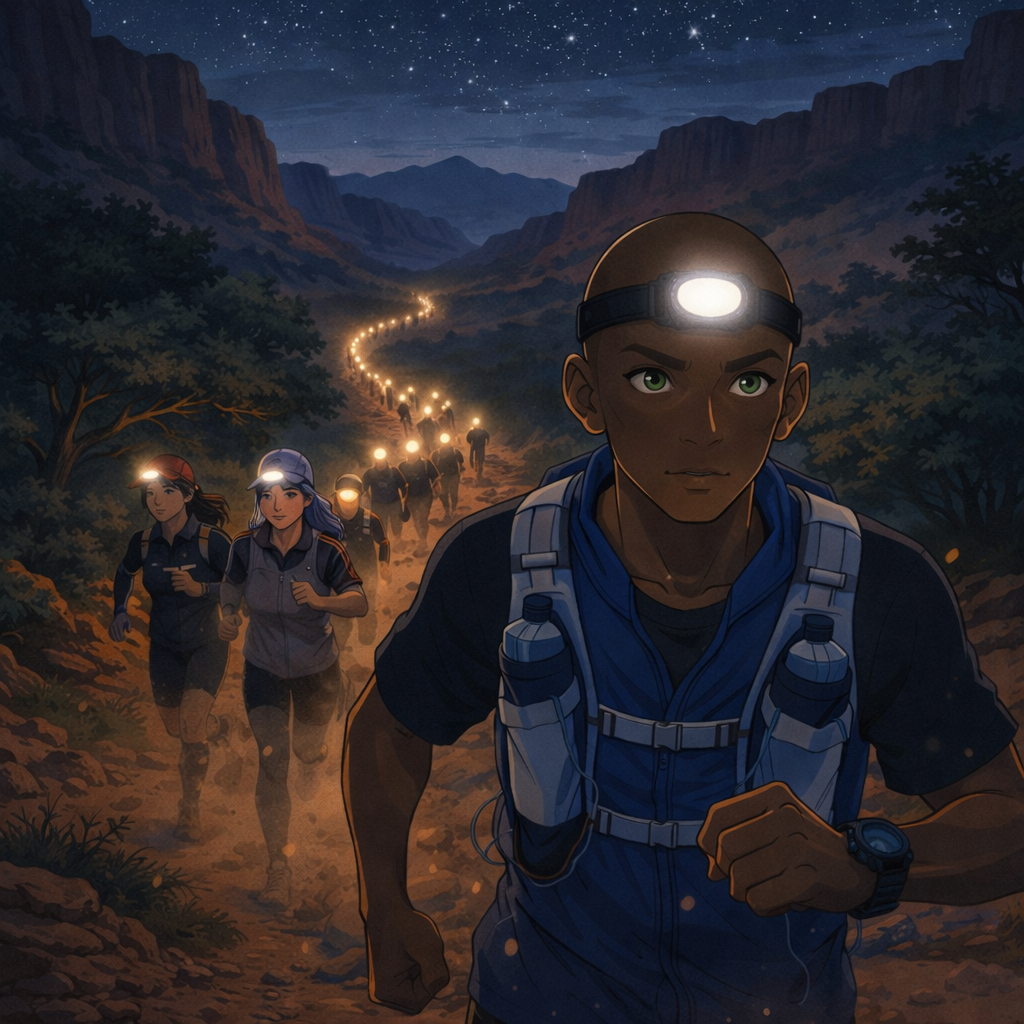
At mile three, the desert is already trying to drink him.
The canyon holds the night the way a fist holds a coin—tight, private, stubborn to open. Headlamps drift ahead in a slow constellation, a chain of small moving stars cutting through red dust and juniper shadow. Shane Koggins runs inside that thin light, black and bald, his scalp slicking under the cold, his green eyes fixed on the pale ribbon of trail as if focus alone can keep the world from widening into too much.
He knows this hunger for distance the way other men know a hometown. Not the romantic version people post in captions, but the real one: the mind bargaining in currencies it never uses anywhere else, the body speaking in tiny alarms and tiny lies. The first miles are always a seduction—everything feels possible, and possibility is its own kind of poison.
His bottle hangs at his hip, and when it bounces, it makes a sound that’s wrong. Not empty, not full—too light, a cheap imitation of security. He doesn’t look. He can tell by the way his tongue touches the roof of his mouth and finds it already beginning to stick.
A year of training compresses into sensations: the salt he swallowed in the dark at 4 a.m. on lonely roads, the ache behind his knee that came and went like a visitor who refused to give his name, the discipline of letting faster runners go because the race begins long after everyone thinks it has begun. He rubs the frayed red wristband on his right wrist—bib number stamped and half-smeared, sweat-softened like an old receipt for something expensive—and remembers his coach’s voice from a different season: Don’t win the first twenty.
Somewhere behind him, shoes kiss gravel faster than his. A presence gathers at his shoulder without needing permission.
Mara Velasquez slides up like a blade finding its sheath. She doesn’t look at him; she doesn’t have to. Her ponytail is a dark thread, her breathing so controlled it sounds rehearsed, but there’s an edge to it—sharp enough that Shane hears the effort she’s pretending not to spend. She taps her watch once, twice, as if time is a door she can knock down.
The trail turns, and for a moment the canyon opens to reveal a strip of sky bruising toward dawn. Wind slides over the ridge above, cool and indifferent. In a few hours, that same wind will feel like someone exhaling a hair dryer into his face.
Mara accelerates on the slight incline, testing him. It’s early, stupid early, but the stupidity has teeth: if he lets her go, she becomes a rumor he’ll have to chase later; if he goes with her, he’ll be spending matches he can’t afford.
Ahead, a faint glow marks the first real aid station—still miles away, but close enough to haunt him. His bottle sloshes again, too lightly, and the tightness behind his knee flickers like a warning light that wants to be ignored. Shane feels the old familiar fork inside himself—pride tugging one way, patience the other—and for a breath he is balanced between them, as if the whole race is waiting to see which version of him will take the next step.
What happens next?
Want to riff your own version of this story? Get RiffRoc